Biography
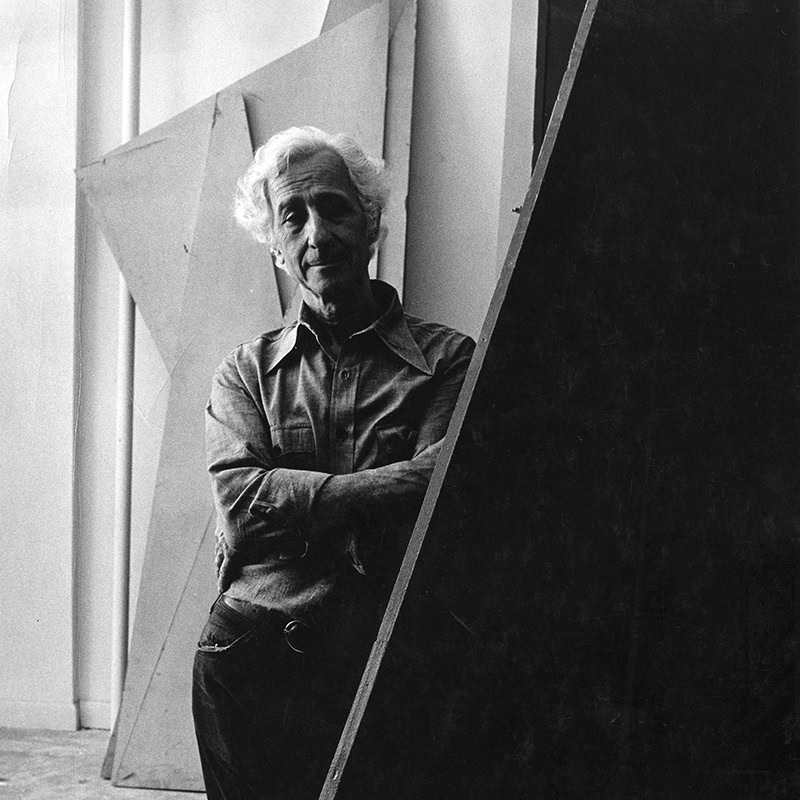
Tony Rosenthal: 1914-2009
Born August 9, 1914, in Highland Park, Illinois, Tony Rosenthal is best known for creating a staggering list of monumental public art sculpture in cities around the world. For over seven decades Tony Rosenthal created an arc of sculpture in a variety of sizes, styles and media, including wood, steel, bronze, brass, cement and aluminum.
After creating The Nubian Slave, 1939, a concrete and plaster sculpture commission for the Elgin Watch Building at the 1939 New York World’s Fair, Tony Rosenthal embarked on a storied 70-year public art career, creating an arc of public art, deco inspired sculpture in the 30s and 40s, figurative sculpture during the 50s and abstract minimalism for the remainder of his career.
Every day millions see, enjoy and interact with monumental public art created by Rosenthal in cities across America. In New York City alone, five Rosenthal public art sculptures have been beloved and visible for over four decades.

Dedicated Life To Art
Tony Rosenthal dedicated his life to creating art and actively created sculptures until he passed away at the age of 94, July 28, 2009. At nine years old, Rosenthal learned the fundamentals of carving sculpture when his mother, an opera singer, enrolled him in children's classes at the Art Institute of Chicago where he learned how to carve sculptures in soap. In 1936 Rosenthal earned a B.F.A. from the University of Michigan and went on to become studio assistant to Alexander Archipenko, the figurative master sculptor, casting bronzes in exchange for sculpture lessons; at night, Rosenthal taught evening classes in drawing and sculpture.
In 1939, Rosenthal enrolled at Cranbrook Academy of Art, studying with Carl Milles, Cranbrook's sculptor in residence; there, Rosenthal forged friendships with husband-and-wife designers Charles Eames and Ray Eames and architect Eero Saarinen. Decades later Rosenthal acknowledged his gratitude to Cranbrook by donating his archives to Cranbrook; The Cranbrook Cube, 1984, 90" painted aluminum cube is in the Cranbrook Museum collection.
In 1942, Rosenthal was drafted into the U.S. Army; while stationed in Paris, Rosenthal forged friendships with George Braque, Andre Derain, Le Corbusier, and Constantin Brancusi, routinely organizing and accompanying groups of soldiers on studio visits.
Through multiple visits to Brancusi's Paris studio, Rosenthal learned to create and forge metal sculptures. While stationed in London, Rosenthal befriended Henry Moore, authoring a 1947 article about Moore for Arts & Architecture Magazine edited by John Entenza. After World War II, Rosenthal moved to Los Angeles, continuing his association with John Entenza and Charles and Ray Eames who introduced Rosenthal to architects who commissioned his public art during the 40s and 50s.
In 1950 Rosenthal was the recipient of the San Francisco Museum of Modern Art’s sculpture award. In 1952 Rosenthal became the very first instructor of sculpture at the University of California, Los Angeles; in 1967, Rosenthal received the outstanding achievement award from the University of Michigan, and in 1963 a Ford Foundation Grant.
Sam Kootz Influence
The 60s were a key turning point for Rosenthal; art dealer Sam Kootz, who also represented Pablo Picasso, began representation of Rosenthal. Kootz persuaded Rosenthal to abandon figurative sculpture and create abstract geometric sculpture which won Rosenthal wide acclaim and recognition. Kootz also encouraged Rosenthal to use his nickname, "Tony," and post-1960, Rosenthal was professionally credited as Tony Rosenthal, including all art created as "Bernard Rosenthal" during the first two decades of his career. Rosenthal had three solo exhibitions at the legendary Kootz Gallery; his final solo exhibition 1966, the year Kootz retired.
Alamo, 1967
Tony Rosenthal's Alamo, 1967, the monumental 15' Cor-Ten steel sculpture, also known as the Astor Place Cube, is without dispute Rosenthal's best known and beloved public art sculpture, considered a New York and public art landmark, was first installed as part of Doris C. Freedman's Sculpture in Environment installation, sponsored by New York's Administration of Recreation & Cultural Affairs.
Arc of a 70 Year Career
 Esteemed American playwright Edward Albee once observed "Tony Rosenthal goes to his studio every day, wrenches steel, bends aluminum, cuts and bolts, fashions and refines. He is both artisan and artist, rendering conscious that which his creative instinct insists upon. He does few preliminary sketches, assuming that what feels right as he does it is a progress of the unconsciously planned." For the first twenty-five years of Rosenthal's career, the entire construction of Rosenthal's sculptures was solely created by the Artist, since he was adept in cutting and welding brass and other metal, even for public art commissions exceeding 10 feet.
It can be said Tony Rosenthal's sculpture presents the solutions for complexity and finding order; sometimes it feels like tackling a problem, and sometimes the appeal is emotional like the gestures of a dance or survival. But Tony Rosenthal sculptures always revel in the element of discovery, finding his way through arrangements of line and space like the power and strength of a candid camera moment, expressing the fleeting excitement of process, remaining because a sculptural rendition is created. Rosenthal allows us to look at remembrance, recalling life as it was, or what we desire that it may be.